The Goal
👷 This post is WIP and will update as I find time to elaborate on the components of the Thinking Process 👷
My brilliant colleague Tonni Hult has got me hooked on Business Novels. Most recently he urged me through the two-part series by Eliyahu M. Goldratt starting with The Goal, originally published in 1984, and followed 10 years later by It’s not luck.
Incredibly fascinating, they follow the life of Plant Manufacturer (turned
Division Manager in the second book) Alex Rogo as he navigates devastating
deadlines managing miraculous turnarouns. Using the Socratic
method of asking questions to
provoke critical thinking the ideas of the Theory of
Constraints, and the
Thinking
Process
(where the first is really derived from the latter) are presented. The latter
involving powerful methods to disect and address virtually any conflict. In
this text I want to focus on the three components of the Thinking Process:
- Current Reality Tree
- Core Conflict Cloud
- Future Reality Tree
When I first laid eyes on these concepts I was immediately hooked. Simple, beautiful and immensely powerful. This post is very much an attempt to incorporate these ideas more into my own thinking, so I’ll try to elaborate on their use-cases and powers below.
Current Reality Tree
The assumption behind the current reality tree is that in a given context, problems/symptoms or issues (referred to as UnDesirable Effects (UDEs)) can all be mapped to a tree-structure, allowing traceability to one or two core problems. Goldratt is careful not to say root cause, since two UDEs can have a root cause, without that being the core problem. The story in the book demonstrates that the process as:
- Gather a list of 5-10 UDEs
- Select two UDEs that seem to relate
- Try to piece the UDEs together using the proposition
If X and Y then Z. (Image to be provided) - If one of the UDEs seem to be derived from the other, but the image doesn’t quite fit, you could have an insufficiency. This can be remedied by adding an extra statement enforcing the causality. Note that loops/cycles are permitted (really making it more like a graph than a tree, but whatever). The implications of a loop will be discussed below.
- When you’re happy with the connection, pick another UDE that you think you might connect to the existing tree. If there are no more UDEs, go to last step.
- Go back to step 3.
- Once the tree contains all UDEs, you may trace it to the bottom, and there you will find the core problem(s).
TODO: discussion on loops, images and an example
Core Conflict Cloud
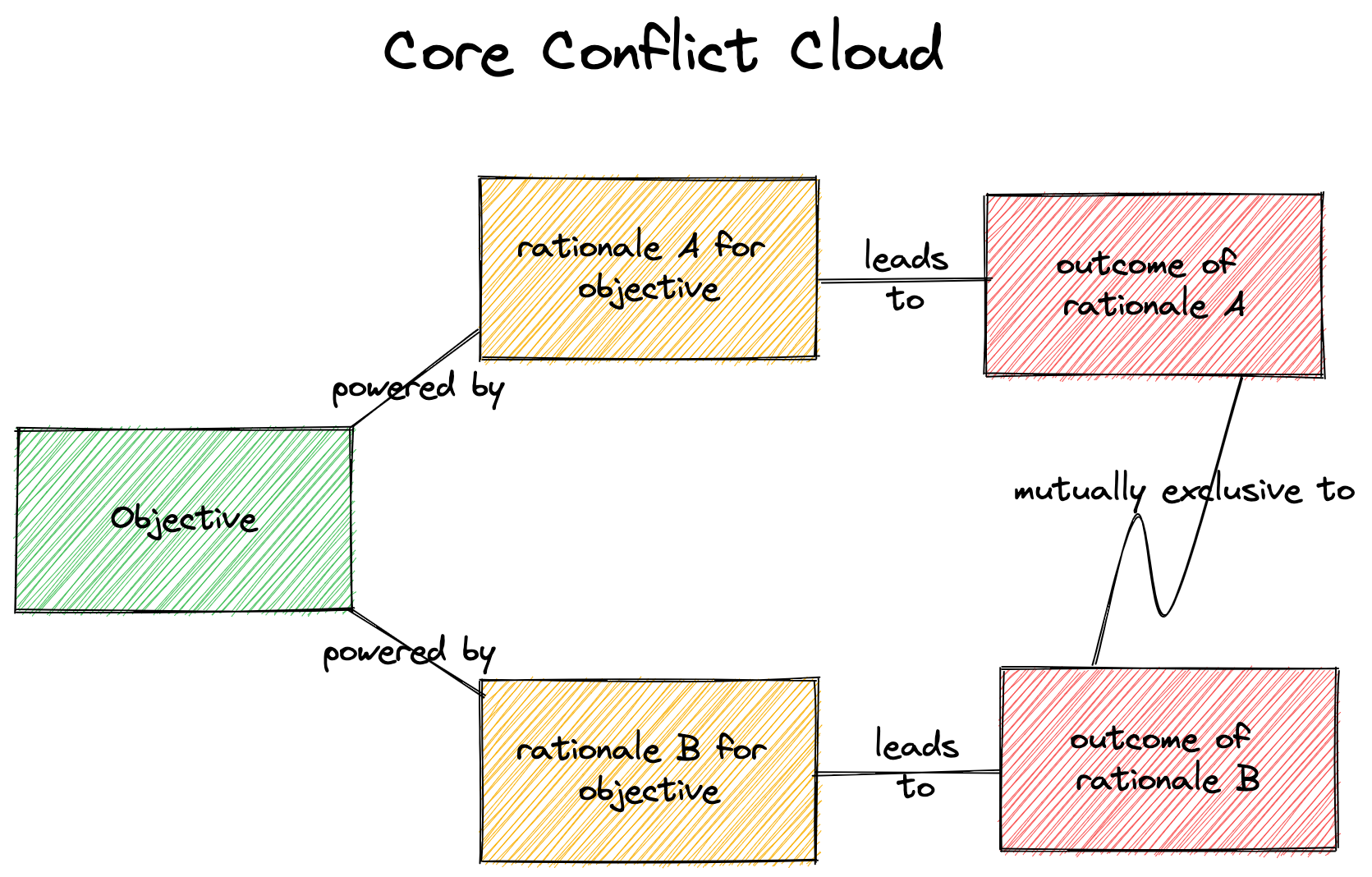
The Core Conflict Cloud is slightly easier to understand. Essentially you pick a problem that you have, which contains two mutually exclusive actions, i.e. the conflict. Then think about the objective causing this conflict, trace it via the rationale underlying the mutually exclusive actions and you get a picture like the banner for this post. The power comes in trying to break the conflict cloud, either by breaking assumptions implicit in the conflict or triggering a new condition rendering an action or rationale invalid.
Future Reality Tree
TBD